Address
304 North Cardinal
St. Dorchester Center, MA 02124
Work Hours
Monday to Friday: 7AM - 7PM
Weekend: 10AM - 5PM
Address
304 North Cardinal
St. Dorchester Center, MA 02124
Work Hours
Monday to Friday: 7AM - 7PM
Weekend: 10AM - 5PM
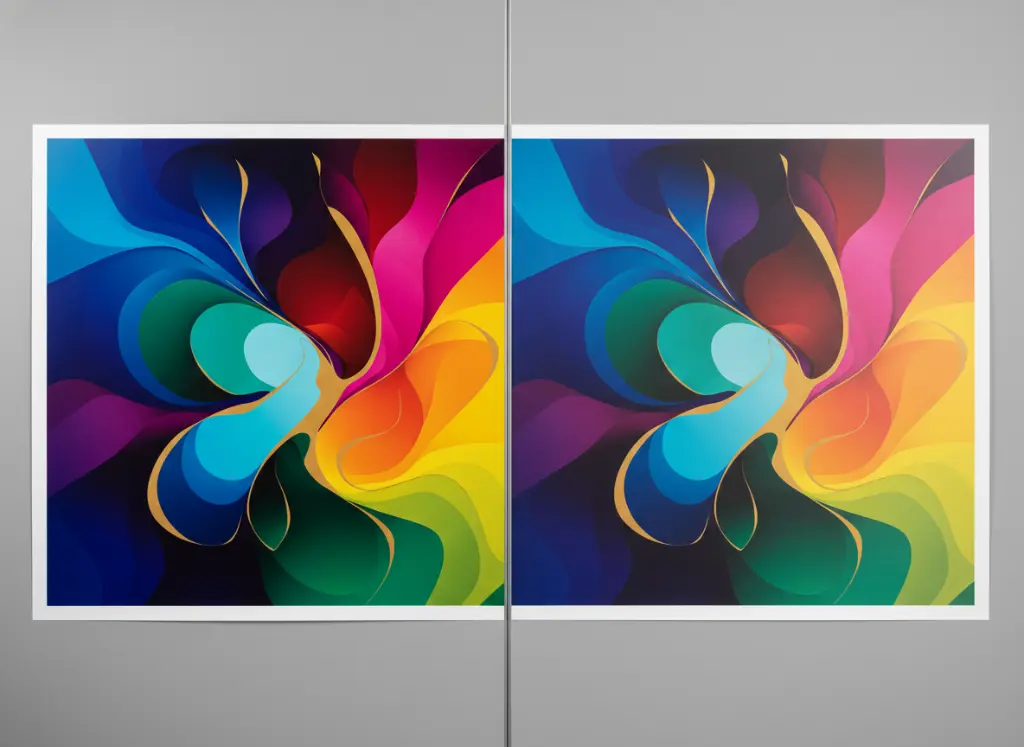
Every brand manager knows the feeling: you receive a digital sample that looks breathtaking—vibrant, sharp, and glowing. You approve it instantly. But when the 5,000-unit mass production order arrives at your warehouse, the colors look “flatter” or slightly darker.
This isn’t necessarily a mistake by the factory; it is a fundamental reality of digital printing vs offset packaging. At Kore Create, we believe that understanding the technical “why” behind this variance is the first step toward a flawless unboxing experience.
The primary reason for color variance in printing lies in the physics of how color is applied to the paper.
Most digital samples are produced using high-end inkjet or laser (toner) technology. These machines often utilize an extended gamut—sometimes up to 11 different ink colors—to simulate vibrancy. The toner or digital ink sits *on top* of the paper fibers, creating a shiny, saturated look that mimics a computer screen.
Offset printing, the gold standard for high-volume Custom Packaging Solutions, uses liquid inks and metal plates. These inks are absorbed into the paper fibers. Because offset typically relies on a 4-color CMYK process (unless specific Pantone spot colors are added), it cannot always replicate the artificial “glow” of a 11-color digital proof.
In the sampling phase, manufacturers often use “digital-ready” stock paper. This paper is pre-treated to hold digital ink perfectly.
However, for mass production, we order industrial rolls of corrugated board or kraft paper. These materials have different “thirsty” levels (absorbency). A recycled kraft paper will soak up offset ink much more aggressively than a digital sample sheet, leading to a more natural, muted finish that might catch an unprepared brand owner off guard.

A common oversight in Printing and Finishing Techniques is the impact of lamination.
Digital samples are frequently provided “naked” (without lamination) to save time. If your final product is laminated but your sample wasn’t, the color shift is guaranteed.
If your brand requires 100% color fidelity—such as a specific “Tiffany Blue” or “Coca-Cola Red”—a digital sample is not enough. You need a Wet Proof.
A Wet Proof (also known as a Press Proof) involves setting up the actual offset press, burning the plates, and running a few sheets of your actual production paper through the machine. While this is more expensive and adds 5–7 days to the timeline, it is the only way to achieve perfect production sample matching.

The difference between a digital sample and a mass-produced box isn’t a sign of poor quality—it’s a sign of different technologies. By acknowledging the limitations of digital proofs and investing in a Wet Proof for color-critical projects, you can avoid the “Sample Trap.”
Ready to ensure your next production run matches your vision? Contact Kore Create today to discuss our advanced color management and sampling protocols.