Address
304 North Cardinal
St. Dorchester Center, MA 02124
Work Hours
Monday to Friday: 7AM - 7PM
Weekend: 10AM - 5PM
Address
304 North Cardinal
St. Dorchester Center, MA 02124
Work Hours
Monday to Friday: 7AM - 7PM
Weekend: 10AM - 5PM
Key Takeaways:
Choosing the right packaging is a pivotal decision that impacts your bottom line and your brand’s perceived value. When evaluating rigid boxes vs folding cartons, many brands find themselves torn between the allure of luxury and the necessity of efficiency. At Kore Create, we help clients navigate these choices by aligning their packaging strategy with their specific market goals. Whether you are launching a boutique skincare line or a mass-market consumer electronic, understanding the structural and financial differences between these retail box types is essential for long-term success.
Folding cartons are the workhorses of the retail world. Manufactured from a single sheet of paperboard, these containers are die-cut, folded, and glued to create a lightweight yet versatile package.
The primary driver for choosing folding cartons is the packaging cost comparison. Because they are made from thinner material, the raw material costs are lower. More importantly, they ship flat. This significantly reduces transportation expenses and warehouse storage requirements. For high-volume custom product boxes, the ability to store thousands of units in a small footprint is a massive logistical advantage.
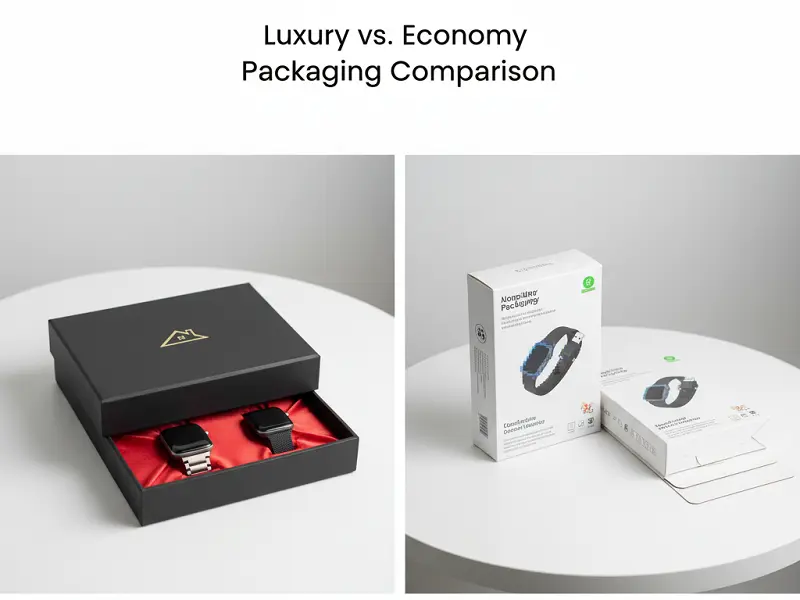
While highly customizable with various coatings and finishes, folding cartons are often perceived as “economy” packaging. They offer moderate protection, making them suitable for lightweight items like cosmetics or pharmaceuticals, but they may struggle with shipping box durability when handling heavier or extremely fragile goods.
If you want your customer to feel they are holding something special before they even see the product, rigid boxes (also known as set-up boxes) are the answer. These are constructed from thick, high-density chipboard and wrapped in decorative paper or fabric.
Rigid boxes do not collapse. This structural integrity provides a sense of permanence and quality that folding cartons simply cannot match. They are the go-to for luxury packaging vs economy debates because they allow for premium features like magnetic closures, ribbon pulls, and intricate internal inserts. Furthermore, their durability often leads customers to keep and reuse the box, providing long-term brand visibility.
The main hurdle for rigid boxes is the price. A packaging cost comparison usually shows rigid boxes costing 3 to 5 times more per unit than folding cartons. Because they do not ship flat, you are essentially paying to ship “air,” and they require significantly more warehouse space.

Folding cartons are the workhorses of the retail world. Manufactured from a single sheet of paperboard, these containers are die-cut, folded, and glued to create a lightweight yet versatile package.
The primary driver for choosing folding cartons is the packaging cost comparison. Because they are made from thinner material, the raw material costs are lower. More importantly, they ship flat. This significantly reduces transportation expenses and warehouse storage requirements. For high-volume custom product boxes, the ability to store thousands of units in a small footprint is a massive logistical advantage.
While highly customizable with various coatings and finishes, folding cartons are often perceived as “economy” packaging. They offer moderate protection, making them suitable for lightweight items like cosmetics or pharmaceuticals, but they may struggle with shipping box durability when handling heavier or extremely fragile goods.
If you want your customer to feel they are holding something special before they even see the product, rigid boxes (also known as set-up boxes) are the answer. These are constructed from thick, high-density chipboard and wrapped in decorative paper or fabric.
Rigid boxes do not collapse. This structural integrity provides a sense of permanence and quality that folding cartons simply cannot match. They are the go-to for luxury packaging vs economy debates because they allow for premium features like magnetic closures, ribbon pulls, and intricate internal inserts. Furthermore, their durability often leads customers to keep and reuse the box, providing long-term brand visibility.
The main hurdle for rigid boxes is the price. A packaging cost comparison usually shows rigid boxes costing 3 to 5 times more per unit than folding cartons. Because they do not ship flat, you are essentially paying to ship “air,” and they require significantly more warehouse space.
For e-commerce brands that need more protection than a folding carton but cannot justify the cost of a rigid box, corrugated mailers offer a middle ground. These provide excellent shipping box durability and can be printed with high-quality graphics to maintain a professional look. While they lack the “heft” of a rigid box, they are much sturdier than standard paperboard and are ideal for direct-to-consumer shipping.
To better understand how to choose between retail box types, consider these two scenarios:
In the debate of rigid boxes vs folding cartons, there is no universal “better” option—only the option that is better for your specific business model. If your goal is to dominate the luxury market and maximize “share-worthy” unboxing moments, the investment in rigid boxes is often the key to unlocking higher price points and customer loyalty. Conversely, if you are scaling a high-volume retail product where margins are tight, the efficiency of folding cartons is unbeatable.
At Kore Create, we specialize in helping brands optimize their packaging for both impact and efficiency. Whether you need the structural strength of a rigid box or the cost-effective versatility of folding cartons, our team can guide you through the sourcing and manufacturing process to ensure your custom product boxes reflect the true value of your brand.