Address
304 North Cardinal
St. Dorchester Center, MA 02124
Work Hours
Monday to Friday: 7AM - 7PM
Weekend: 10AM - 5PM
Address
304 North Cardinal
St. Dorchester Center, MA 02124
Work Hours
Monday to Friday: 7AM - 7PM
Weekend: 10AM - 5PM
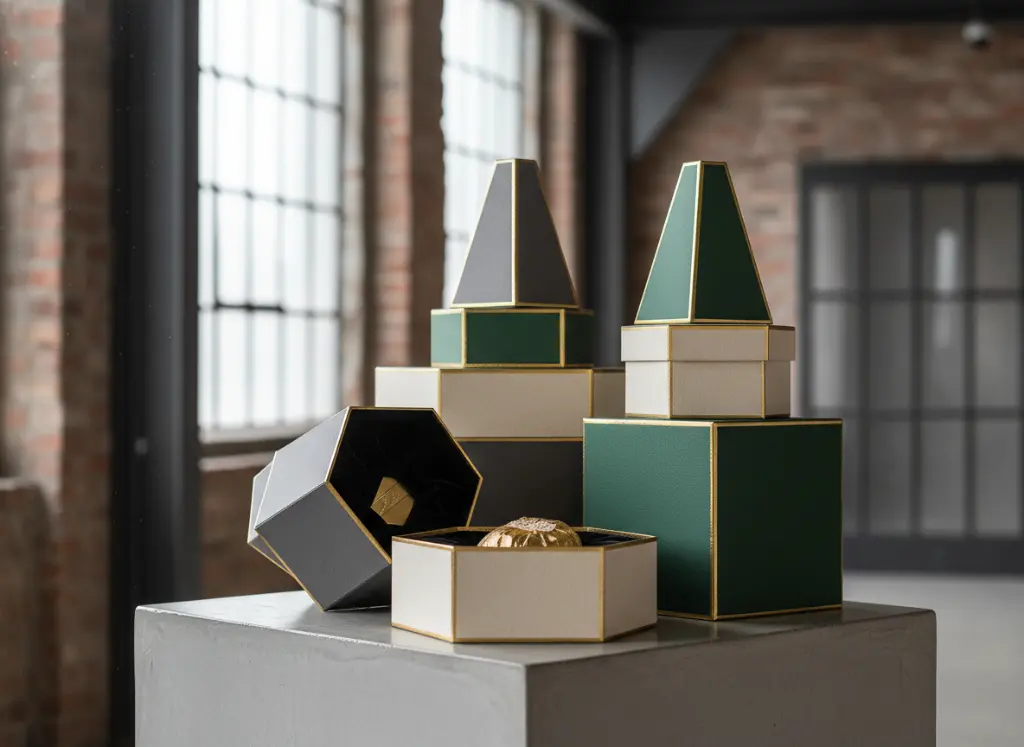
The era of the standard cuboid is ending. In the hyper-competitive retail landscape of 2026, the “unboxing experience” has evolved from a marketing buzzword into a critical operational metric. With the global die-cut boxes market valued at approximately $8.33 billion in 2026, brands are no longer just asking for boxes; they are demanding structural innovation that disrupts the visual monotony of the retail shelf.
At Kore Create, we have observed a decisive shift. The square box, while efficient, is invisible. Today’s consumer, driven by social media aesthetics and a desire for premium tactile experiences, gravitates toward packaging that defies geometry. Whether it is a hexagonal box for artisanal honey or a pyramid structure for luxury tea blends, custom shaped packaging is the most direct way to signal value before the product is even touched.
However, moving away from standard squares introduces complex challenges in manufacturing, structural engineering, and logistics. This guide explores the industrial reality of producing non-standard die-cut packaging in 2026, moving beyond the aesthetics to the engineering and economics that make these shapes viable.
The demand for unique geometries has surged, driven largely by the beauty, food, and luxury gift sectors. In 2026, three specific shapes have dominated the custom packaging requests at Kore Create, each serving a distinct functional and aesthetic purpose.
Hexagon Boxes (The Honey & Beauty Standard)
The hexagon has become the defining shape for the organic and luxury beauty markets in 2026. Its six-sided structure offers a natural association with honeycombs, making it the default choice for artisanal honey brands and beeswax-based cosmetics. Beyond semantics, the hexagon is structurally efficient; it approaches the cylindrical efficiency of a tube but retains flat panels for branding and ingredient lists. We are seeing a trend toward “telescopic” hexagon boxes, where the lid slides over the base, creating a friction-fit reveal that adds a moment of anticipation to the unboxing.
Pyramid Boxes (Tea & Confectionery)
Pyramid boxes are strictly a niche for high-margin, small-volume items. They are widely used in 2026 for single-serving luxury tea bags or high-end truffles. The triangular geometry is inherently stable at the base but offers zero stacking capability without secondary packaging. This shape is purely about shelf disruption; a pyramid cannot be ignored when placed among a sea of rectangles.
Pillow Boxes (Events & Small Gifts)
The pillow box remains the champion of cost-effective creative packaging. Curved and convex, it requires minimal assembly and often no adhesive, relying on tension to stay closed. In 2026, we are seeing these used heavily for jewelry and corporate event giveaways. The “pillow” shape is less about protection and more about an elegant, soft presentation for lightweight items.

To understand how these shapes are achieved, one must understand the tooling. The industry standard for volume production remains the steel rule die—essentially a giant, industrial-grade “cookie cutter.”
In this process, a custom tool is fabricated using razor-sharp steel blades bent into the exact shape of your box design. These blades are embedded into a laser-cut wood board. The die is then mounted on a press, which stamps the shape out of corrugated board or paperboard sheets with tons of pressure.
However, 2026 has brought significant advancements in how we approach this process:
The most common failure in custom shaped packaging is not aesthetic—it is structural. A square box transfers load vertically through its corners, the strongest part of the structure. A pyramid or a hexagon distributes weight differently, often creating weak points that can collapse during shipping.
At Kore Create, we engineer structural integrity into non-standard shapes using two primary methods:
Flute Profile Selection
For corrugated custom shapes, the choice of “flute” (the wavy middle layer) is critical. In 2026, we frequently utilize E-flute or F-flute for die-cut boxes. These thinner profiles offer a smoother printing surface for high-quality graphics while providing the density needed to hold intricate folds without cracking. A standard B-flute might be too thick for a small hexagon box, causing the fold lines to look ragged or “checked.”
Internal Supports & Grain Direction
Grain direction—the alignment of the paper fibers—dictates the strength of the box. For a hexagonal box, the grain must run perpendicular to the primary load-bearing panels to prevent bulging. Furthermore, unique shapes often require custom inserts. We design internal corrugated platforms that lock the product in place and provide a flat “false top” or “false bottom,” allowing these odd-shaped boxes to be stacked inside a standard master shipping carton without being crushed.
Innovation comes with a price tag. Moving from a standard RSC (Regular Slotted Container) to a custom die-cut shape introduces specific cost drivers that brands must budget for in 2026.
Sustainability is the dominant trend of 2026. The “waste” associated with die-cutting is under scrutiny, and Kore Create is leading the charge with eco-conscious manufacturing.
We are seeing a massive shift toward mono-material designs. In the past, a custom shaped box might have used a plastic window to show the product. Today, we use laser-cut windows or translucent paper patches to maintain a 100% curbside recyclable profile.
Furthermore, the “stripping” waste (the paper removed from the die-cut sheet) is immediately baled and recycled back into the paper supply chain. By using unbleached Kraft materials and soy-based inks, even the most complex custom shape can remain a champion of the circular economy.

Custom shaped boxes are a powerful tool for brand differentiation. They transform a commodity product into a luxury experience and turn the physical package into a brand ambassador. However, success requires “thinking outside the square” not just in design, but in engineering.
By understanding the die-cutting process, respecting the laws of structural integrity, and planning for the economic realities of production, brands can launch packaging that is as functional as it is beautiful. At Kore Create, we are ready to help you break the mold.