Address
304 North Cardinal
St. Dorchester Center, MA 02124
Work Hours
Monday to Friday: 7AM - 7PM
Weekend: 10AM - 5PM
Address
304 North Cardinal
St. Dorchester Center, MA 02124
Work Hours
Monday to Friday: 7AM - 7PM
Weekend: 10AM - 5PM
The retail landscape for vaping products in 2026 is unrecognizable compared to just a few years ago. As the industry has matured, so has the sophistication of the consumer and the strictness of regulatory bodies. Walking into a high-end vape shop today feels less like visiting a tobacconist and more like entering a boutique electronics store. In this hyper-competitive environment, the vessel that holds the product is just as critical as the oil or hardware inside. For brands looking to dominate the shelf, securing high-quality custom vape boxes wholesale is no longer an option; it is a strategic necessity.
At Kore Create, we have observed a distinct shift in how successful brands approach their physical presentation. The days of flimsy, generic cardstock are over. Today, vape cartridge packaging serves three distinct masters: the regulatory agencies demanding compliance, the retailers demanding shelf efficiency, and the consumers demanding a premium unboxing experience. This triple threat requires a packaging strategy that is precise, durable, and visually arresting.
Whether you are launching a new line of live resin cartridges or a sleek rechargeable pen battery, the packaging must communicate value instantly. With the market flooded with options, your product has roughly three seconds to catch a customer’s eye on a crowded pegboard. This is where the engineering of hang tab boxes and the artistry of print finishes collide. In this deep dive, we will explore the technical and aesthetic elements that define top-tier vape packaging in 2026, ensuring your brand stands out in a crowded vape shop.
The visual noise in a modern dispensary or vape retail outlet is intense. Rows of colorful boxes, varying shapes, and aggressive branding compete for attention. In 2026, the trend has moved away from the chaotic, cartoonish graphics of the early 2020s toward a more refined, “tech-luxury” aesthetic. Brands are now leveraging custom vape boxes wholesale to create a cohesive brand identity that screams reliability and safety.
Differentiation starts with structure. While the standard tuck-end box remains popular, we are seeing a surge in rigid drawer boxes and magnetic closure systems for higher-end hardware. However, for the high-volume cartridge market, the folding carton remains king due to its cost-effectiveness and versatility. The key to standing out is not necessarily reinventing the wheel but perfecting it. This means sharp crease lines, high-quality cardstock that doesn’t buckle under humidity, and graphics that align perfectly across the folds.
Furthermore, the integration of window cutouts has evolved. Rather than simple rectangular holes, brands are using die-cut windows shaped like their logos or oil droplets, allowing the consumer to see the quality of the oil (the “golden viscosity”) while keeping the cartridge secure. This transparency builds trust. When a customer picks up vape cartridge packaging that feels solid and looks professional, they subconsciously attribute those same qualities to the hardware inside. At Kore Create, we emphasize that your packaging is your silent salesman, working the floor every time a potential buyer glances your way.

One of the most significant challenges in the vape industry is the sheer smallness of the product. A standard 1ml vape cartridge or a 10ml bottle of e-liquid is minute. Packaging these items requires a level of precision that standard packaging often fails to deliver. If a box is even a millimeter too large, the cartridge rattles, creating a perception of cheapness and increasing the risk of breakage. If it is a millimeter too small, the assembly line jams, or the packaging tears during fulfillment.
In 2026, precision manufacturing is the baseline. At Kore Create, we utilize automated die-cutting technology with tolerance levels tighter than ever before. This is particularly crucial for “micro-packaging”—boxes designed for single 0.5ml carts or disposable stick pens. These tiny footprints reduce shipping costs and storage space, but they leave zero room for error.
For 10ml e-liquid bottles, the challenge is twofold: containing the bottle securely and providing enough surface area for the mandatory regulatory text. We often employ “extended flap” designs or internal inserts that hold the bottle in place while adding external volume to the box. This makes the product harder to shoplift and provides the necessary canvas for branding and warnings.
Moreover, the internal structure is just as important as the external shell. Custom inserts—whether paper pulp, foam, or folded cardstock—must be engineered to cradle the specific hardware. We are seeing a massive shift away from plastic blister packs inside boxes toward fully recyclable paperboard inserts. This not only aligns with 2026 sustainability goals but also elevates the unboxing experience. When a customer slides out the tray of their vape cartridge packaging, the device should be presented like a piece of jewelry, not a toy.
Retail logistics dictate design. In the vast majority of smoke shops and convenience stores, vape products are sold from behind the counter, often displayed on pegboards to maximize vertical space. This reality makes hang tab boxes a critical form factor for the industry. However, the execution of the hang tab has become a major point of innovation and debate regarding sustainability.
Historically, the industry relied on glued plastic hang tabs. These were clear pieces of PVC adhered to the back of the box. While functional, they are a nightmare for recycling streams and often detach if the adhesive fails in high-heat environments (like a shipping container). In 2026, the industry standard has shifted decisively toward the “integrated hang tab.”
An integrated hang tab is cut from the same sheet of paperboard as the box itself. It is an extension of the rear panel that folds up and locks into place. This design offers superior strength because it is part of the structural integrity of the box, not an add-on. It eliminates single-use plastic entirely, a major selling point for eco-conscious consumers and a requirement in certain jurisdictions with strict plastic reduction laws.
At Kore Create, we design these integrated tabs to be “sombrero” or “euro-style” cuts, ensuring they fit all standard retail pegs globally. We also engineer them to fold flat during shipping. This is a crucial logistical detail: boxes with protruding plastic tabs take up significantly more space in a master carton, increasing shipping costs. Integrated tabs that lay flat until retail deployment allow for denser packing, reducing the carbon footprint of logistics. For brands sourcing custom vape boxes wholesale, this small design choice yields massive savings in freight and storage.

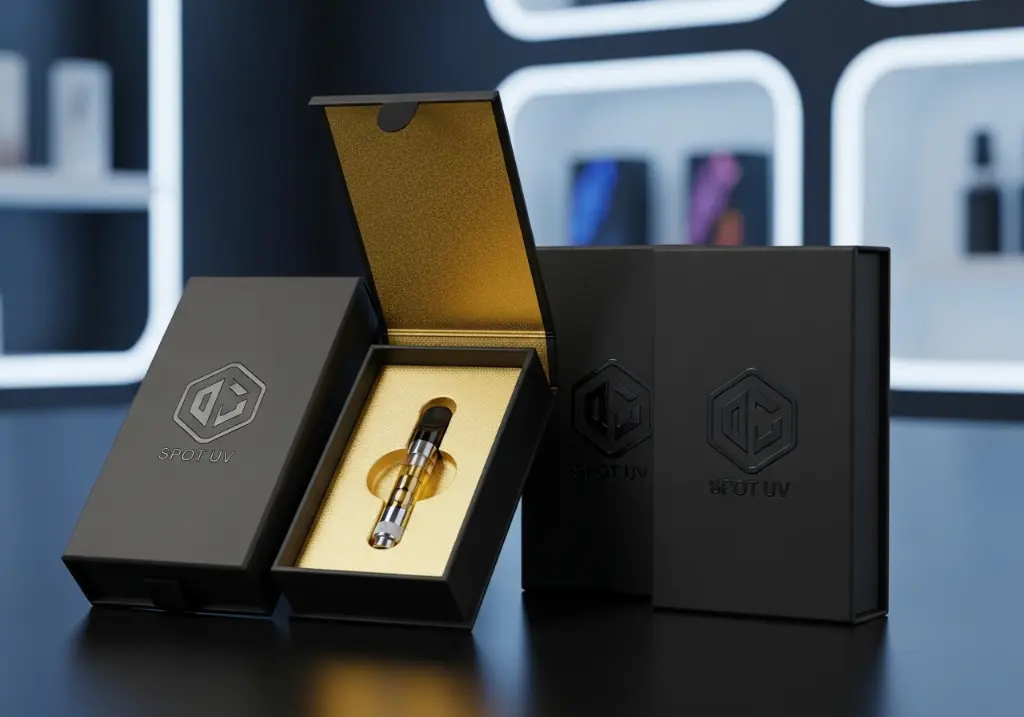
If you pick up a premium vape pen box in 2026, it likely feels different than a standard cereal box. It feels soft, almost velvety. This is the result of “Soft-Touch” lamination, a finish that has become the de facto industry standard for premium vape hardware. Soft-touch provides a tactile experience that immediately signals luxury. It reduces the slick, cheap feel of standard gloss coating and offers a sophisticated matte appearance that absorbs light rather than reflecting it.
However, a fully matte box can look flat or dull on a shelf. To counter this, successful brands pair soft-touch lamination with “Spot UV.” Spot UV is a high-gloss clear polymer applied to specific areas of the design—usually the logo, a pattern, or the product name. The contrast between the velvety matte background and the high-gloss, slightly raised Spot UV creates a dynamic visual and tactile effect. When a customer tilts the box under the store lights, the logo pops.
This combination is not just about aesthetics; it is about psychology. The vape market is flooded with counterfeits. High-end finishing techniques like Soft-Touch and Spot UV are difficult and expensive to replicate for bootleggers using cheap digital printers. Therefore, investing in these finishes for your vape cartridge packaging acts as a secondary layer of brand protection. It tells the consumer, “This is authentic. This is quality.”
Beyond these two staples, we are also seeing a resurgence of foil stamping in 2026. Holographic foils, in particular, are popular for fruit-flavored e-liquids, while copper and gold foils are favored for tobacco and dessert blends. The key is restraint. Overusing foil can look tacky; using it as an accent on a soft-touch box looks elegant. Kore Create advises clients to use these finishes strategically to guide the eye to the most important information: the brand name and the strain or flavor profile.
Design is art, but packaging is law. In 2026, the regulatory environment for vaping products in the United States and globally is more rigorous than ever. The FDA and other international bodies have strict requirements regarding nicotine warnings, ingredient listings, and manufacturer information. Non-compliance is not a minor infraction; it results in product seizures and recalls that can bankrupt a brand.
The challenge for designers is integrating these massive blocks of mandated text without ruining the aesthetic appeal of the packaging. For example, the standard requirement often dictates that the nicotine warning must cover at least 30 percent of the two principal display panels. This leaves limited real estate for branding.
At Kore Create, we view these constraints as creative challenges. We utilize high-resolution printing techniques that ensure even the smallest regulatory text is legible and crisp. Smudged or bleeding text is a red flag for regulators and consumers alike. We also employ creative structural designs, such as “fifth panel” boxes (boxes with a front flap that opens like a book). This allows the warning to be prominent on the outer face as required, while the interior flap provides a clean canvas for brand storytelling, usage instructions, or flavor notes.
Furthermore, “Child-Resistant” (CR) packaging is non-negotiable for products containing nicotine. While the bottle or cartridge itself often has CR features, many jurisdictions now require the secondary packaging (the box) to be child-resistant as well. This has led to the innovation of locking mechanisms on hang tab boxes and slide-out drawers that require a specific “push-and-slide” action to open. These mechanisms must be intuitive for adults but baffling for children. We test these designs rigorously to ensure they meet the Consumer Product Safety Commission (CPSC) standards for 2026.

Looking ahead, the trajectory for custom vape boxes wholesale is clear: smarter, safer, and greener. We are already prototyping boxes with embedded NFC tags that allow consumers to scan the package with their smartphone to view lab results, verify authenticity, and access recycling instructions. This “smart packaging” bridges the physical and digital worlds, offering brands a direct line of communication to their customers.
Sustainability will continue to drive material choices. We are moving beyond just recyclable cardstock to using hemp-based papers and soy-based inks, creating a product that is fully aligned with the plant-based nature of the industry. Brands that ignore this shift risk alienating a large segment of the market that values environmental responsibility.
In conclusion, vape cartridge packaging in 2026 is a high-stakes game of engineering and design. It requires balancing the microscopic precision needed for 10ml bottles with the macroscopic visibility needed for retail pegboards. It demands a mastery of finishes like soft-touch and spot UV to convey luxury and trust. And above all, it requires an unwavering commitment to regulatory compliance.
For brands ready to elevate their presence, Kore Create offers the expertise and technology to turn these challenges into competitive advantages. Your packaging is the first thing your customer sees and the last thing they touch before experiencing your product. Make it count. Small boxes truly do have a big impact.